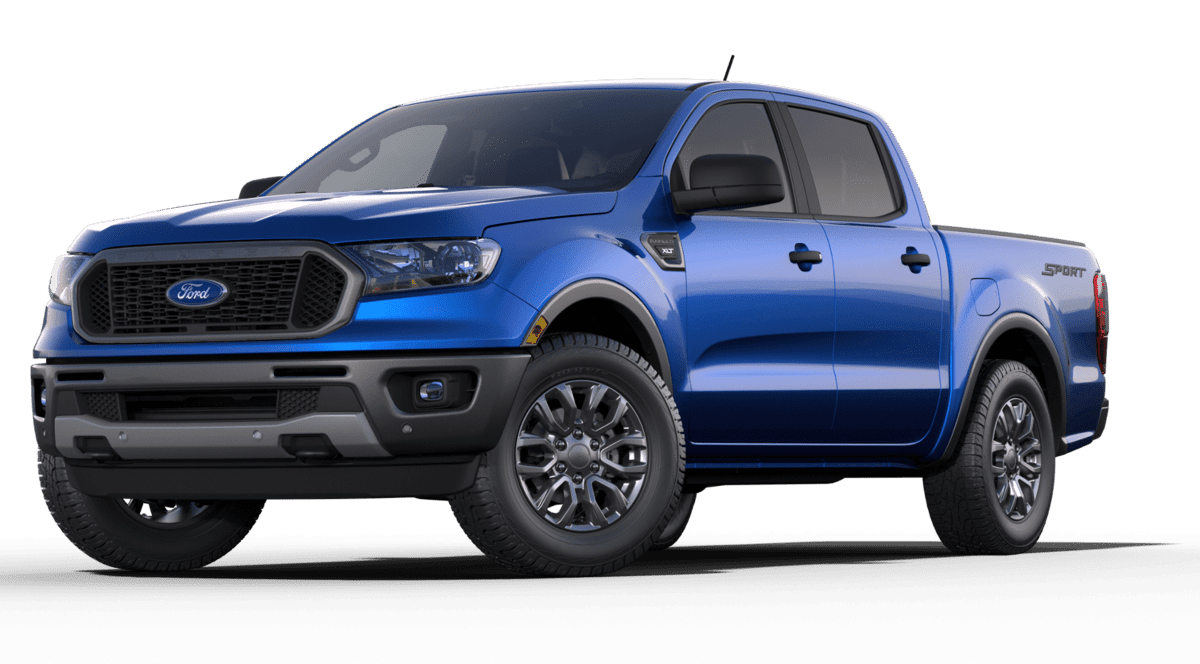
NHTSA ID Number: 10233585
Manufacturer Communication Number: TSB 23-2062
Summary
Some 2019-2023 Ranger crew cab vehicles may exhibit excessive latching effort when returning the rear seat backrest assembly to the upright position. This may be due to oversized rear seat backrest bumpers preventing latch to striker engagement. Vehicles built on or before 04-Feb-2019 may also have excessive deadening material inside the rear seat backrest latch. To correct this condition, follow the Service Procedure to replace the rear seat backrest bumpers and adjust the striker position.
This bulletin supersedes 22-2026.
Model:
Ford
2019-2023 Ranger |
Summary
This article supersedes TSB 22-2026 to update the vehicle model years affected.
Issue: Some 2019-2023 Ranger crew cab vehicles may exhibit excessive latching effort when returning the rear seat backrest assembly to the upright position. This may be due to oversized rear seat backrest bumpers preventing latch to striker engagement. Vehicles built on or before 04-Feb-2019 may also have excessive deadening material inside the rear seat backrest latch. To correct this condition, follow the Service Procedure to replace the rear seat backrest bumpers and adjust the striker position.
Action: Follow the Service Procedure to correct the condition on vehicles that meet all of the following criteria:
- 2019-2023 Ranger
- Crew cab
- Excessive latching effort when returning the rear seat backrest assembly to the upright position
Parts
| Service Part Number | Quantity | Description | Unit of Issue | Piece Quantity |
| KB3Z-9961383-A | 1 | Rear Seat Back Latch | 1 | 1 |
| KB3Z-2161082-B | 3 | Bumper | 1 | 3 |
| W504694-S424 | 1 | Screw | 4 | 3 |
| 164-R4903 | As Needed | Flock Tape (Rotunda Part Number) | ||
| Obtain Locally | As Needed | String – 2-Foot (60 Cm) Long | ||
| Obtain Locally | As Needed | Modeling Clay |
Quantity refers to the amount of the service part number required to repair the vehicle.
Unit of Issue refers to the number of individual pieces included in a service part number package.
Piece Quantity refers to the total number of individual pieces required to repair the vehicle.
Unit of Issue and Piece Quantity are 1 unless otherwise stated.
As Needed indicates the amount of the part may vary and/or is not a whole number. Parts can be billed out as non-whole numbers, including less than 1.
Service Procedure
1. Check the vehicle build date. Was the vehicle built on or before 04-Feb-2019?
(1). Yes – proceed to Step 2.
(2). No – proceed to Step 14.
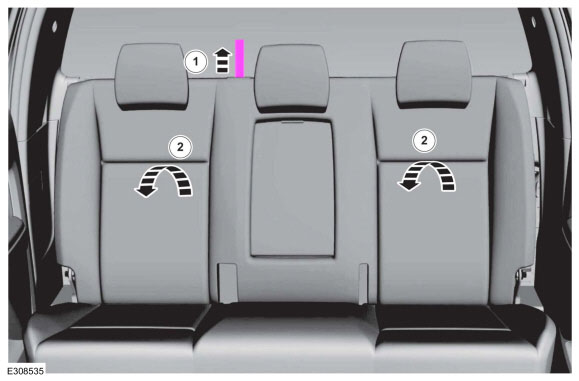
2. Release the rear seat backrest latch (Figure 1 Callout 1) and lower to the fold flat position. (Figure 1 Callout 2)
Figure 1
3. Measure and cut a 60 cm (2-foot) piece of string. (Figure 2)
Figure 2
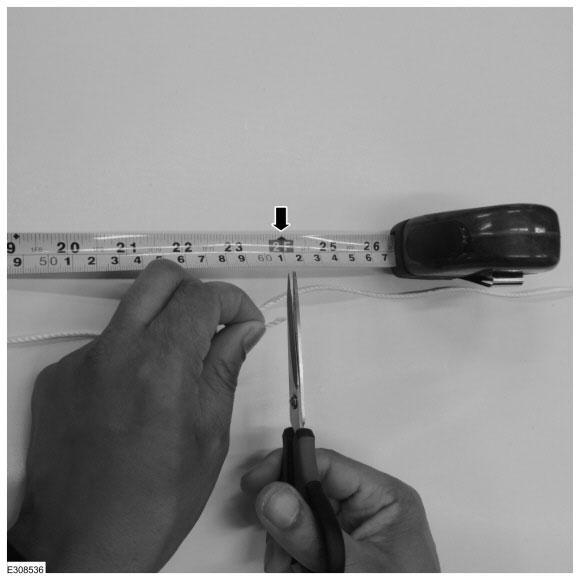
CAUTION: Using metal wire can damage the seat backrest cover. Use string to avoid any damage.
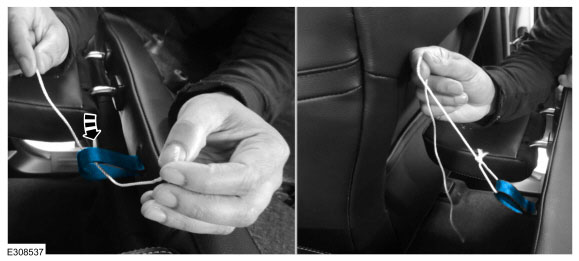
4. Guide the string through the rear seat backrest release strap and double knot a loose loop. (Figure 3)
Figure 3
5. Remove the rear seat backrest latch retainers. (Figure 4)
Figure 4
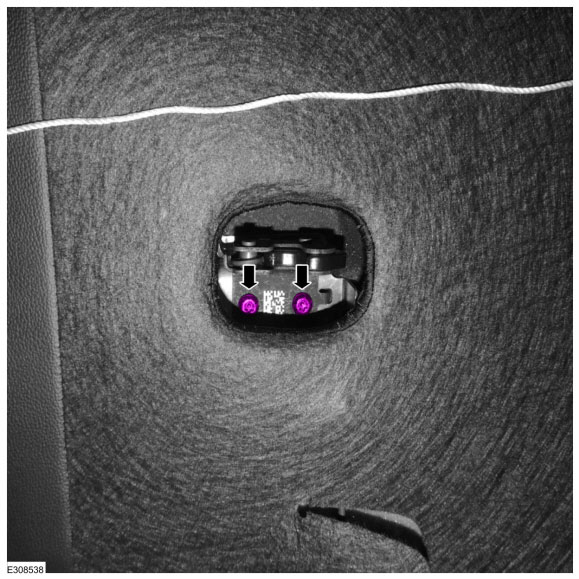
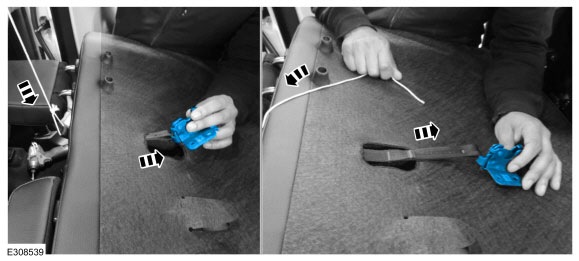
6. Holding the string, guide the rear seat backrest latch up and out of the rear seat backrest assembly just enough to access and remove the rear seat backrest latch release strap. (Figure 5)
Figure 5
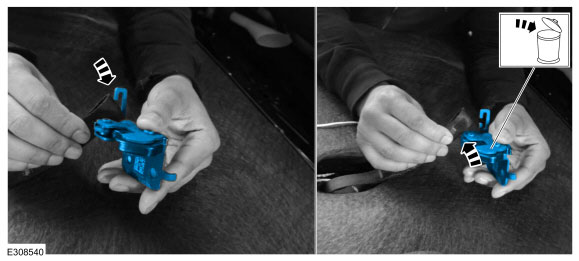
7. Remove and discard the rear seat backrest latch from the rear seat backrest release strap. (Figure 6)
Figure 6
8. Install the rear seat backrest release strap onto the new rear seat backrest latch.
9. Install the new rear seat backrest latch by pulling the string attached to the rear seat backrest release strap back through the seat backrest cover and guiding the rear seat backrest latch back into the rear seat backrest assembly. (Figure 5)
10. Install the rear seat backrest latch retainers. (Figure 4)
(1). Tighten both retainers to 1.2 Nm (10.6 in-lb).
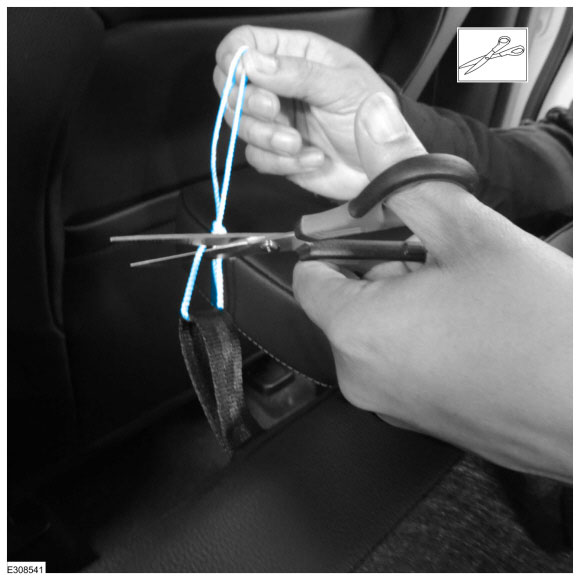
11. Remove the string attached to the rear seat backrest release strap. (Figure 7) Make sure to cut the string as far away from the rear seat backrest release strap as possible or damage to the release strap may occur.
Figure 7
12. Remove and discard the passenger side inboard rear seat backrest bumper on the backside of the rear seat backrest assembly. (Figure 8)
Figure 8
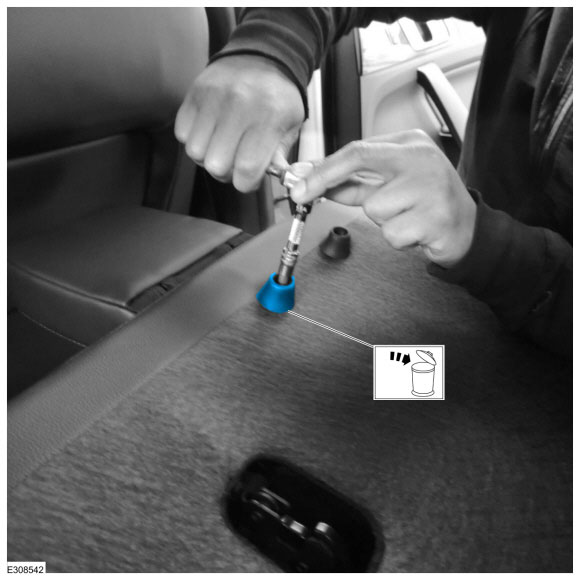
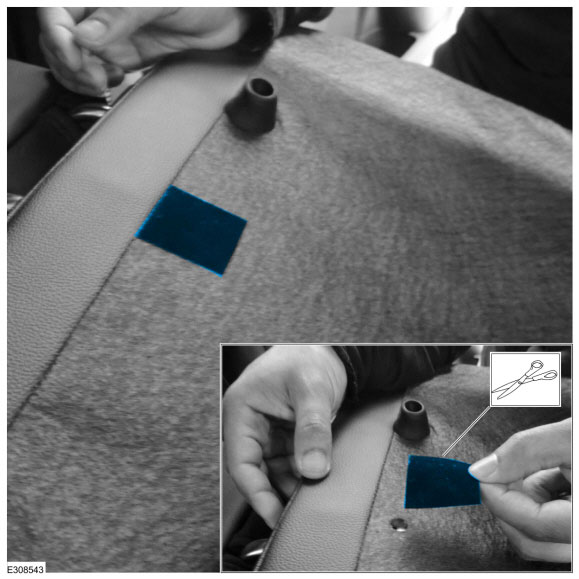
13. Cut a 40 mm by 40 mm (1.5 inch by 1.5 inch) piece of flock tape and install it over the rear seat backrest bumper retainer hole. (Figure 9)
Figure 9
14. Remove only the rear seat outermost head restraints.
(1). Press inward on the head restraint locks.
(2). Lift upward on the head restraint.
15. Replace all 3 rear seat backrest bumpers and fasteners. Tighten to 1.6 Nm (14 lb-in)
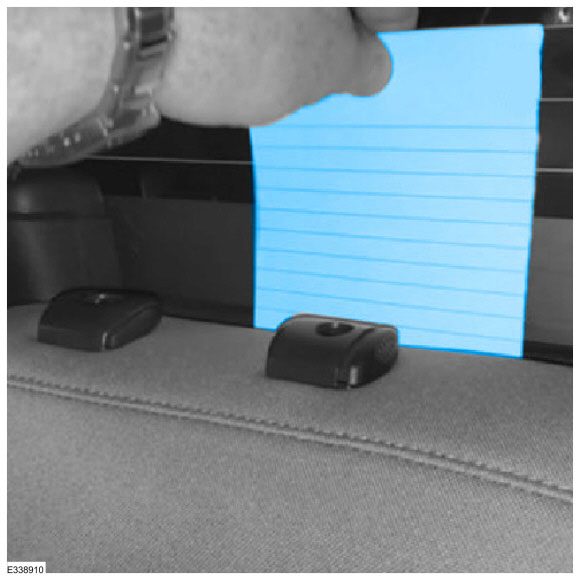
16. Perform a drag test using a sheet of paper to determine which of the 3 rear seat backrest bumpers contacts the back of the cab first.
(1). While covering one rear seat backrest bumper with a sheet of paper, raise the rear seat backrest so it is in the upright position, but not latched, and lightly tug on the paper to determine if that bumper is contacting the rear of the cab. Repeat this test on all 3 bumpers.
(2). The rear seat backrest bumper that holds the paper will be considered rear seat backrest bumper ‘X’. Remember the location of rear seat backrest bumper ‘X’, as it will be used later in the procedure. (Figure 10)
NOTE: If more than one seat backrest bumper is found to be contacting the rear of the cab, the bumper closest to the latch should be considered rear seat backrest bumper ‘X’.
Figure 10
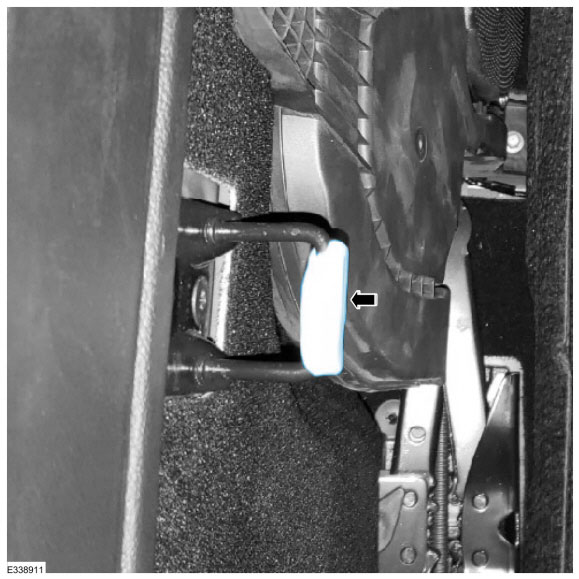
17. Use modeling clay to measure the position of the rear seat back rest latch relative to the striker.
(1). With the rear seat backrest assembly folded to the flat position, apply modeling clay to the width of the striker. The modeling clay should be no more than 5mm thick on the forward side of the striker. (Figure 11)
(2). While holding a sheet of paper over rear seat backrest bumper ‘X’, raise the rear seat backrest assembly until vertical.
(3). Allow gravity to pull the rear seat backrest assembly the rest of the way against the modeling clay while lightly tugging on the paper to confirm when the rear seat backrest bumper ‘X’ is against the cab. If the paper is not being held, apply very light pressure near rear seat backrest bumper ‘X’ until resistance can be felt when tugging on the paper.
Figure 11
NOTE: Applying too much pressure against the rear seat backrest may compress the rear seat backrest bumpers and give a false impression in the modeling clay.
18. Lower the rear seat backrest assembly to the fold flat position and inspect the impression in the modeling clay left by the rear seat backrest latch. Is the striker visible through the modeling clay? (Figure 12)
(1). Yes – no adjustments to the rear seat backrest bumpers are necessary, however, material may be removed from the rubber bumpers to reduce seat latching efforts for customer preference, but removing too much material may result in rear seat backrest noise, vibration, and harshness (NVH) concerns.
(2). No – proceed to Step 19.
Figure 12
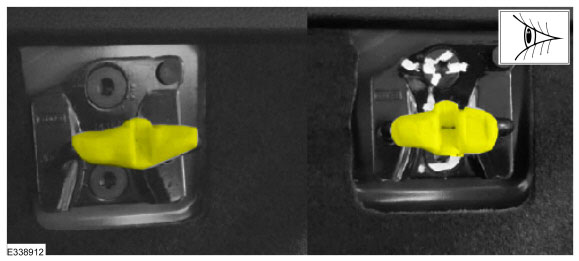
19. Using a knife or blade, cut away half of the modeling clay through the center of the impression to show a cross section of the impression left by the rear seat backrest latch. (Figure 13)
Figure 13
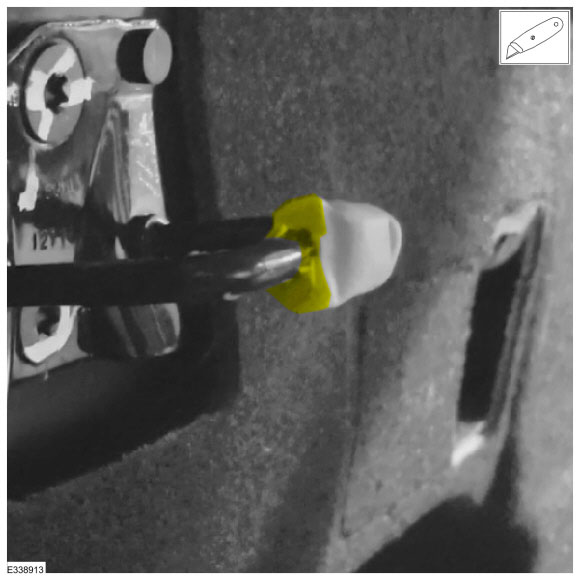
20. Using a ruler or dial caliper, measure the distance between the striker and the deepest part of the impression left in the modeling clay by the rear seat backrest latch. This measurement will be how much material is to be removed from each rear seat backrest bumper. (Figure 14)
Figure 14
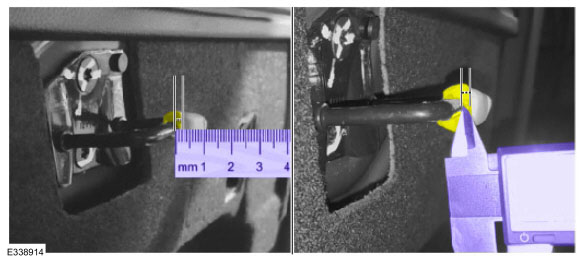
21. Per the modeling clay measurement, mark the top of each rear seat backrest bumper in 4 places, 90° apart, to indicate the amount of material to be removed.
22. Using sand paper or sanding block (80 grit is preferred), remove the measured amount of material from each rear seat backrest bumper. Make sure that any shavings are cleaned prior to returning the vehicle to the customer.
NOTE: The amount of material removed when using this measuring process should allow for reasonable latching efforts without creating any NVH related issues. Additional material may be removed to further reduce seat latching efforts for customer preference but removing too much material may result in rear seat backrest NVH concerns.
23. Remove all modeling clay from the striker.
24. Raise and latch the rear seat backrest assembly.
25. Install the rear seat outermost head restraints.
5 Affected Products
Vehicle
| MAKE | MODEL | YEAR |
| FORD | RANGER | 2019-2023 |
1 Associated Document
Manufacturer Communications
23-2062
29 March 2023
MC-10233585-0001.pdf 230.214KB
NHTSA ID Number: 10207891
Manufacturer Communication Number: TSB 22-2026
Summary
Some 2019-2022 Ranger crew cab vehicles may exhibit excessive latching effort when returning the rear seat backrest assembly to the upright position. This may be due to oversized rear seat backrest bumpers preventing latch to striker engagement. Vehicles built on or before 04-Feb-2019 may also have excessive deadening material inside the rear seat backrest latch. To correct this condition, follow the Service Procedure to replace the rear seat backrest bumpers and adjust the striker position.
1 Associated Document
Manufacturer Communications
22-2026
03 February 2022
MC-10207891-0001.pdf 573.753KB
NHTSA ID Number: 10187832
Manufacturer Communication Number: TSB 21-2036
Summary
Some 2019-2021 Ranger crew cab vehicles may exhibit excessive latching effort when returning the rear set backrest assembly to the upright position. This may be due to oversized rear seat backrest bumpers preventing latch to striker engagement. Vehicles built on or before 04-Feb-2019 may also have excessive deadening material inside the rear seat backrest latch. To correct this condition, follow the Service Procedure Steps.
1 Associated Document
Manufacturer Communications
21-2036
16 February 2021
MC-10187832-0001.pdf 589.073KB
NHTSA ID Number: 10180338
Manufacturer Communication Number: TSB 20-2218
Summary
Some 2019-2020 Ranger Crew Cab vehicles may exhibit excessive latching effort when returning the rear seat backrest assembly to the upright position. This may be due to oversized rear seat backrest bumpers preventing latch to striker engagement. Vehicles built on or before 04-Feb-2019 may also have excessive deadening material inside the rear seat backrest latch. To correct this condition, follow the Service Procedure steps.
1 Associated Document
Manufacturer Communications
20-2218
08 September 2020
MC-10180338-0001.pdf 810.313KB
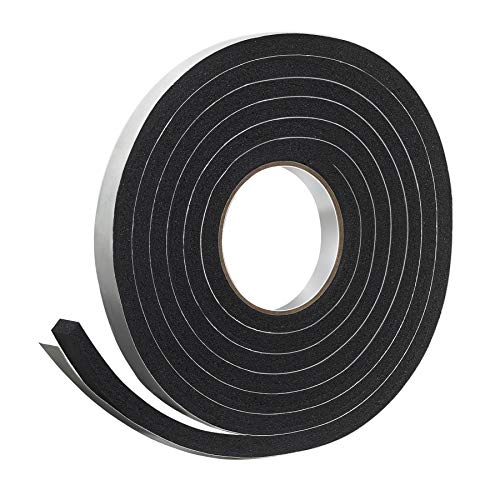
- The product is 3/4x7/16 BLK SpongeTape
- Easy and simple use kit
- The product is manufactured in China
- Minimum Compression
- Superior Shock Absorbing


- Package Include: you will get 1 roll 13 mm x 50 m foam masking tape, offers reliable protection against overspray, dust, and debris, ensuring that your car's door jams remain clean and free from paint contamination during refinishing; Please note: do not place the product in the sun for a long time to avoid oxidation and yellowing of the sponge
- Easy Application and Removal: the tape's self-adhesive backing allows for effortless application; It promise securely during the painting process and can be removed without leaving any sticky residue, saving time and effort during clean up
- Soft Edge Foam Design: soft edge foam masking tape confirms smoothly to the contour of car and truck door jams, suitable for use on wood, metal, and plastic surfaces
- Meet Various Needs: our tape can be torn into one or more strips to meet various masking needs; Also a good choice for painting projects to protect surfaces
- Versatile Usage: with a long length, this edge foam masking tape ensures you have an ample supply to complete multiple projects; The longer roll reduces the need for frequent replacements, enhancing efficiency in your automotive refinishing tasks

- Car Speaker Sealing Tape Size:5/64 inch(2mm) Thick x 25/64 inch(10mm) Wide x 33ft(10M)
- Foam Tape Material: Foam tape is made of EVA .High density foam, The foam in this sponge tape is made to provide a completely airtight seal. This makes it ideal for weather stripping cabinets or Insulation tapes for wrapping pipes Sheet metal panels where an air-tight seal is required.
- Application:The single sided foam tape is widely used for doors, window, furniture, cabinets, speaker, pipes, air conditioning sealing
- Function:Weatherproof, oil resistance, resistant to corrosion, dustproof, shock-absorbing, sound insulation, anti-skidding and insulating
- Easy-to-install: Keep the paste area clean and dry before use;Determine the seal size in advance and cut to use
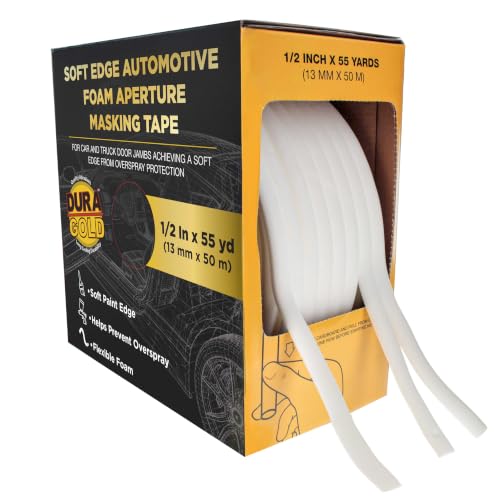
- Fast, Effective Jamb Masking: Automotive Soft Edge Foam Aperture Masking Tape. 1/2 inch wide x 55 yards long (13mm x 50m) roll in a dispenser box. A premium three-dimensional foam tape that conforms smoothly to the contours of car and truck door jambs, hood openings, and trunk and deck lid openings on vehicles before painting.
- Superior Overspray & Contaminant Seal: The foam tape is applied into the gaps (apertures) between panels. When the door, hood, or deck lid is closed, the flexible foam compresses to seal the opening effectively. It protects the interior of the jamb from paint overspray and seals out dust and contaminants that could otherwise be blown into the wet paint during the painting process.
- Soft Edge Transition: Unlike traditional flat masking tape, which leaves a hard, sharp paint line, the foam structure allows the paint to feather or transition gradually into the foam. This creates a "soft" or "blended" paint edge, making the paint job look more professional and reducing the need for extensive compounding or buffing to hide hard tape lines.
- Foam Material: Flexible premium polyurethane foam that conforms easily to curves and unique contours. It features an adhesive that allows for repositioning before firm pressure is applied, making application easier. The tape withstands the heat of paint spray booth bake cycles.
- Dura-Gold Quality: Trust Dura-Gold for a complete line of professional-grade, high-quality automotive supplies that help you save time and achieve exceptional results.
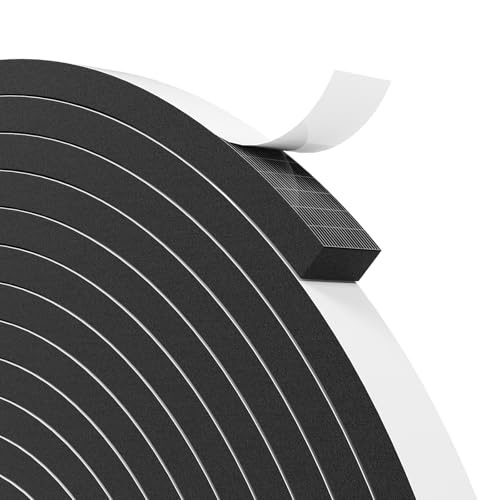
- [Newly upgraded mesh adhesive]: The upgraded mesh adhesive ensures the longest adhesion, is easy to operate, and is highly prone to peeling and sticking. Moreover, the presence of grid lines can ensure that the adhesive is firmly attached to the strip without leaving any traces
- [Flexible variability]: It is soft and larger, larger than the common foam strips on the market. Random cutting has more flexible usability, no longer worrying about gaps that are too large to fill, waterproof and thermal insulation, ensuring comfort for families
- [100% EVA material]: Compared with silicone and EPDM materials on the market, silicone has higher density, better toughness, longer lifespan, and relatively strong temperature resistance. Raw materials are more expensive, ensuring quality while also being more aesthetically pleasing
- [Multiple application scenarios]: Doors/windows/ventilation openings/air conditioners/refrigerators/refrigerators/cars/RVs/table corners/sofa legs/trays/machine tools/garages, there are only places you can't think of, there are no places it can't use
- [Multi purpose]: sealing/anti-collision/shaking/anti friction/anti-collision/protecting table corners/floor mats/insulation/sound insulation/light blocking, super strong adhesion suitable for various places, replacing old sealing strips is also a good choice
SEOCONTENT-START
TECHNICAL SERVICE BULLETIN Crew Cab – Folding Rear Seat Backrest Assembly Excessive Latching Effort When Returning To The Upright Position 23-2062 29 March 2023 This bulletin supersedes 22-2026. Model: Ford 2019-2023 Ranger Summary This article supersedes TSB 22-2026 to update the vehicle model years affected. Issue: Some 2019-2023 Ranger crew cab vehicles may exhibit excessive latching effort when returning the rear seat backrest assembly to the upright position. This may be due to oversized rear seat backrest bumpers preventing latch to striker engagement. Vehicles built on or before 04-Feb-2019 may also have excessive deadening material inside the rear seat backrest latch. To correct this condition, follow the Service Procedure to replace the rear seat backrest bumpers and adjust the striker position. Action: Follow the Service Procedure to correct the condition on vehicles that meet all of the following criteria: • 2019-2023 Ranger • Crew cab • Excessive latching effort when returning the rear seat backrest assembly to the upright position Parts Service Part Number Quantity Description Unit of Issue Piece Quantity KB3Z-9961383-A 1 Rear Seat Back Latch 1 1 KB3Z-2161082-B 3 Bumper 1 3 W504694-S424 1 Screw 4 3 164-R4903 As Needed Flock Tape (Rotunda Part Number) Obtain Locally As Needed String – 2-Foot (60 Cm) Long Obtain Locally As Needed Modeling Clay Quantity refers to the amount of the service part number required to repair the vehicle. Unit of Issue refers to the number of individual pieces included in a service part number package. Piece Quantity refers to the total number of individual pieces required to repair the vehicle. Unit of Issue and Piece Quantity are 1 unless otherwise stated. As Needed indicates the amount of the part may vary and/or is not a whole number. Parts can be billed out as non- whole numbers, including less than 1. Warranty Status: Eligible under provisions of New Vehicle Limited Warranty (NVLW)/Service Part Warranty (SPW)/Special Service Part (SSP)/Extended Service Plan (ESP) coverage. Limits/policies/prior approvals are not altered by a TSB. NVLW/SPW/SSP/ESP coverage limits are determined by the identified causal part and verified using the OASIS part coverage tool. Labor Times Description 2019-2023 Ranger Crew Cab: Replace And Adjust Backrest Bumpers Following The Service Procedure (Do Not Use With Any Other Labor Operations) Operation No. 232062A Time 0.4 Hrs. 2019-2023 Ranger Crew Cab: Replace The Rear Seat Backrest Latch And Bumpers Includes Time To Adjust Backrest Bumpers Following The Service Procedure (Do Not Use With Any Other Labor Operations) 232062B 0.5 Hrs. Repair/Claim Coding Causal Part: 9961383 Condition Code: 42 Service Procedure 1. Check the vehicle build date. Was the vehicle built on or before 04-Feb-2019? (1). Yes – proceed to Step 2. (2). No – proceed to Step 14. 2. Release the rear seat backrest latch (Figure 1 Callout 1) and lower to the fold flat position. (Figure 1 Callout 2) Figure 1 3. Measure and cut a 2 foot (60 cm) piece of string. (Figure 2) Figure 2 CAUTION: Using metal wire can damage the seat backrest cover. Use string to avoid any damage. 4. Guide the string through the rear seat backrest release strap and double knot a loose loop. (Figure 3) Figure 3 5. Remove the rear seat backrest latch retainers. (Figure 4) Figure 4 6. Holding the string, guide the rear seat backrest latch up and out of the rear seat backrest assembly just enough to access and remove the rear seat backrest latch release strap. (Figure 5) Figure 5 7. Remove and discard the rear seat backrest latch from the rear seat backrest release strap. (Figure 6) Figure 6 8. Install the rear seat backrest release strap onto the new rear seat backrest latch. 9. Install the new rear seat backrest latch by pulling the string attached to the rear seat backrest release strap back through the seat backrest cover and guiding the rear seat backrest latch back into the rear seat backrest assembly. (Figure 5) 10. Install the rear seat backrest latch retainers. (Figure 4) (1). Tighten both retainers to 1.2 Nm (10.6 in-lb). 11. Remove the string attached to the rear seat backrest release strap. (Figure 7) Make sure to cut the string as far away from the rear seat backrest release strap as possible or damage to the release strap may occur. Figure 7 12. Remove and discard the passenger side inboard rear seat backrest bumper on the backside of the rear seat backrest assembly. (Figure 8) Figure 8 13. Cut a 1.5 inch by 1.5 inch (40 mm by 40 mm) piece of flock tape and install it over the rear seat backrest bumper retainer hole. (Figure 9) Figure 9 14. Remove only the rear seat outermost head restraints. (1). Press inward on the head restraint locks. (2). Lift upward on the head restraint. 15. Replace all 3 rear seat backrest bumpers and fasteners. Tighten to 1.6 Nm (14 lb-in) 16. Perform a drag test using a sheet of paper to determine which of the 3 rear seat backrest bumpers contacts the back of the cab first. (1). While covering one rear seat backrest bumper with a sheet of paper, raise the rear seat backrest so it is in the upright position, but not latched, and lightly tug on the paper to determine if that bumper is contacting the rear of the cab. Repeat this test on all 3 bumpers. (2). The rear seat backrest bumper that holds the paper will be considered rear seat backrest bumper X. Remember the location of rear seat backrest bumper X, as it will be used later in the procedure. (Figure 10) NOTE: If more than one seat backrest bumper is found to be contacting the rear of the cab, the bumper closest to the latch should be considered rear seat backrest bumper X. Figure 10 17. Use modeling clay to measure the position of the rear seat back rest latch relative to the striker. (1). With the rear seat backrest assembly folded to the flat position, apply modeling clay to the width of the striker. The modeling clay should be no more than 5mm thick on the forward side of the striker. (Figure 11) (2). While holding a sheet of paper over rear seat backrest bumper X, raise the rear seat backrest assembly until vertical. (3). Allow gravity to pull the rear seat backrest assembly the rest of the way against the modeling clay while lightly tugging on the paper to confirm when the rear seat backrest bumper X is against the cab. If the paper is not being held, apply very light pressure near rear seat backrest bumper X until resistance can be felt when tugging on the paper. Figure 11 NOTE: Applying too much pressure against the rear seat backrest may compress the rear seat backrest bumpers and give a false impression in the modeling clay. 18. Lower the rear seat backrest assembly to the fold flat position and inspect the impression in the modeling clay left by the rear seat backrest latch. Is the striker visible through the modeling clay? (Figure 12) (1). Yes – no adjustments to the rear seat backrest bumpers are necessary, however, material may be removed from the rubber bumpers to reduce seat latching efforts for customer preference, but removing too much material may result in rear seat backrest noise, vibration, and harshness (NVH) concerns. (2). No – proceed to Step 19. Figure 12 19. Using a knife or blade, cut away half of the modeling clay through the center of the impression to show a cross section of the impression left by the rear seat backrest latch. (Figure 13) Figure 13 20. Using a ruler or dial caliper, measure the distance between the striker and the deepest part of the impression left in the modeling clay by the rear seat backrest latch. This measurement will be how much material is to be removed from each rear seat backrest bumper. (Figure 14) Figure 14 21. Per the modeling clay measurement, mark the top of each rear seat backrest bumper in 4 places, 90° apart, to indicate the amount of material to be removed. 22. Using sand paper or sanding block (80 grit is preferred), remove the measured amount of material from each rear seat backrest bumper. Make sure that any shavings are cleaned prior to returning the vehicle to the customer. NOTE: The amount of material removed when using this measuring process should allow for reasonable latching efforts without creating any NVH related issues. Additional material may be removed to further reduce seat latching efforts for customer preference but removing too much material may result in rear seat backrest NVH concerns. 23. Remove all modeling clay from the striker. 24. Raise and latch the rear seat backrest assembly. 25. Install the rear seat outermost head restraints. © 2023 Ford Motor Company All rights reserved. NOTE: The information in Technical Service Bulletins is intended for use by trained, professional technicians with the knowledge, tools, and equipment to do the job properly and safely. It informs these technicians of conditions that may occur on some vehicles, or provides information that could assist in proper vehicle service. The procedures should not be performed by “do-it-yourselfers”. Do not assume that a condition described affects your car or truck. Contact a Ford or Lincoln dealership to determine whether the Bulletin applies to your vehicle. Warranty Policy and Extended Service Plan documentation determine Warranty and/or Extended Service Plan coverage unless stated otherwise in the TSB article. The information in this Technical Service Bulletin (TSB) was current at the time of printing. Ford Motor Company reserves the right de this information with updates. The most recent information is available through Ford Motor Company’s on-line technical resources.
SEOCONTENT-END
This product presentation was made with AAWP plugin.